

This is likely a photograph of a young Thomas Cahoon. To learn more about Thomas, go to frame #25.
Category Archives: Cahoon
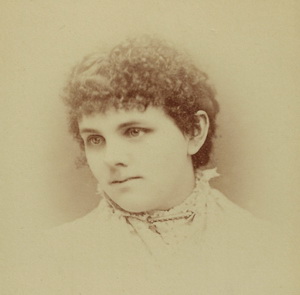
Frame #39: Elizabeth Hughes Cahoon
b. 19 Nov. 1830, Ohio
d. 4 Oct. 1914, Cleveland, Ohio
Elizabeth Hughes was the first child of Richard Hughes and Elizabeth Elder. She married Thomas Havenner Cahoon in Cincinnati, Ohio on March 27, 1860. They settled in Cleveland and had one daughter together, Effie, and adopted another daughter, Anna. Elizabeth passed away at the age of 84, outliving both her husband and Effie. She is buried in Lakeside Cemetery.

Emmeline “Emma” Hackett Cahoon
b. 1808
d. 1876, Elyria, Ohio
Emmeline “Emma” Hackett Cahoon was born in 1808. She married Benjamin Cahoon on December 1, 1835. They had at least eight children together. Their daughters can be seen in a group portrait at Rose Hill in frames #8 and #22. She was described by Ida Cahoon, in her book History of the Cahoon Family, as “…a most excellent wife and model mother.” Emma lived to be 68 years old and is buried in Ridgelawn Cemetery, Elyria, Ohio.

A Child’s Memory of the Cahoon Sisters
by Michele Yamamoto
At the Bay Village Historical Society archives we have recently come across a couple of remembrances of the Cahoon sisters. They were written by two former residents of Bay Village who recalled their time growing up in the town over 100 years ago. It is an interesting peek into what the sisters, Lydia, Laura Martha and Ida Cahoon, may have been like.
In “Remembering the Cahoons,” written by Wilfred C. Swanker (1907-1983) for Westlife in 1982, Swanker wanted to make sure that the Cahoon sisters’ characters were correctly recorded. “They were very civic minded,” he wrote. They opened their property up to the public long before giving it to the City of Bay Village in 1917. “The Cahoons engendered a spirit which I feel still prevails today. Their foresight was superb. They were a decent and kindly family which lived their religion.”

Ida, Lydia and Laura Cahoon about 1910, 1996.P.012
Swanker remembered the ladies giving the public access to their beach. Children unaccompanied by parents were requested to check in with the Cahoons for their own safety. “They opened their beach and grounds to the public when nobody else did. They built dressing rooms for the public as well as a pair of outdoor toilets.” A set of men’s dressing rooms were on the west side of Cahoon creek and another for ladies was on the east side. Swanker notes that this was before the building of Huntington Beach, whose stone levees contributed to coastal erosion on the Cahoons’ beach.
Another account of the Cahoon sisters was handwritten on notepaper by Roger Jewitt (1891-1993) in 1959. He was sharing his memories after a call was put out by the Kiwanis Club in a local paper and as part of the 150th celebration of Dover Township (Bay Village). Jewitt stated that he was the youngest child of Dr. E.H. Jewitt, physician to the Cahoon family, who summered in a cottage on the Cahoon property from 1896 to about 1912. Roger jokes that his boyhood pranks may have caused the sisters to practically disinherit his father. Indeed, only a Dr. Clifton Dalton Ellis (the husband of Ida’s cousin, Effie Cahoon) is mentioned in the Cahoon will.
Jewitt also wrote about the Cahoon family and their beach. He hinted that the sisters could actually be very forgiving in the defiance of their rule of not allowing bathers on Sundays. “The religious old gals put up and still up (under their wills) on Cahoon Beach a sign ‘No Boating or Bathing on Sunday.’ Every Sunday A.M. with their field glasses they checked me as a bather and if the culprit turned up in the Methodist Church my violation was condoned because I washed for the Lord. Tough quandary each Sunday for a growing boy.”
Swanker does mention in his article that the women may have had an interesting bathing habit. “Saturday morning was quite practically set aside for taking a bar of Ivory soap (it floats) and modestly taking a bath while wearing your bathing suit. You had to be a bit of a gymnast.”

Cahoon Creek meeting Lake Erie at Cahoon Beach, October 1940, 2000.P.FIC.119
Perhaps the ladies were just softies for the kids. Swanker talks about how the sisters would talk to the children who visited them and take an interest in their activities. “They were school teachers and liked kids. I remember they often wore high lace collars. For some reason the collars interested me.” Jewitt remembered Ida “would cover my neck and face with kisses with loud smacking of lips, as I resembled my doctor father, her best friend, charity on a young boy’s part.”
The Fourth of July was a time of big celebrations in Bay over a hundred years ago and the Cahoon property was a part of this even before Bay Days. Swanker wrote that “the Cahoons threw open their grounds and people came from all over. Picnics were a must. There were other families with much land but it was always the Cahoons who offered. No one else did. We had lots of races and contests and the Cahoons gave prizes. Fireworks were not like they are now but we thought they were the greatest.”
Swanker mentions that the sisters were ahead of their time. One small example was given in the way Ida Cahoon (1852-1917) chose to commute to work. “I remember Ida, the little one, riding her bicycle to teach school in what is now Westlake. In those days, very few women ever learned to ride a bike. It was considered unladylike. The Cahoons were a very modern family. I wish I had their acumen and foresight.”
*********************
We hope you enjoyed this glimpse into the lives of the Cahoon sisters. If learning historical information such as this is important to you, please consider a donation to the Bay Village Historical Society. Find out more on our website Support Us Page. You may also contact us by phone at (216) 319-4634 or email info@bayhistorical.com.
Another way to support us is by attending our benefit historical fashion show Silhouettes of Style, September 24, 2023 at Lakewood Country Club. Details can be found on our website events and programs page at www.bayhistorical.com.
Come visit us Sundays, April through December (excluding holiday weekends) from 2 p.m.- 4:30 p.m. at the Rose Hill Museum. Currently on display for 2023 is our temporary exhibition, Beadwork: The Beauty of Small Things, as well as our permanent collection concerning early Bay Village history.

Ornamental Beadwork
Ornamental Beadwork
by Barbara Comienski, Collections Volunteer/ Docent, Bay Village Historical Society
The Rose Hill Museum is excited to be premiering our special exhibition for the year on ornamental beadwork in costumes and accessories Beadwork: The Beauty of Small Things. Every room features an aspect of beadwork, in addition to the museum’s permanent displays.
Beads have been in existence between 70,000-100,00 years. Originally beads were fashioned totally of natural materials such as bone, shell, or wood. Metal and glass beads followed. Often these beads were strung as jewelry and were a visible sign of prosperity. For centuries few people could afford to embellish clothing with beadwork. One needed the wealth to buy beads and then to have the workforce to apply these to clothing and accessories.

Blue satin beaded bodice, 1860s, 1996.C.132

Eyeglasses with beaded case, owned by Ida Cahoon, circa 1910s,1996.C.624AB
Embellishment followed trends with beads losing popularity, then resurging. Lush fabrics and pearl and gemstone jewelry were popular in the 1700s, but simpler styles in the early 1800s resulted in less use of beadwork. The mid-nineteenth century invention of the sewing machine focused attention on fabric embellishment; however, jet beads resurged in the 1880s. Decorative accents were achieved in the nineteen teens with metallic thread and sequins until glass beads returned to popularity in the 1920s.

Vase dripping with beads. Blue beaded necklace circa 1910s on left, 2005.C.08
The special exhibit includes jewelry and actual embellished garments. Early twentieth century Campfire Girls’ Indian dresses on display in the basement area replicate the wooden bead patterns used by Native American artisans. The Cahoon Library displays include wooden beads from Africa, and silver and stone ones from Mexico; other mediums include bones, polished stones, pearls, and even paper beads!
The historical society’s beaded purses, also on display in the library, show the intricacies of design possible in beadwork, as do design school sample strips from the newly accessioned collection of items from the Darvas School of Fashion Arts in Cleveland from which several Bay Village residents graduated. The school, established in 1910, operated into the 1950s. Students would use these design samples to learn beading skills.

Blue-green and peach chiffon gown with beaded overlay, circa 1910s, 1996.C.121. At bottom is an evening bag of white seed beeds with a pink flower motif, 2004.C.03.
Rose Hill is fortunate to have some beautifully preserved late nineteenth century berthas, bodices, and dresses ornamented in beads, a variety of 1920s beaded flapper dresses, and a stunning mid-twentieth century pink dress with silver beading upstairs. Even children’s clothing in the Nursery has beaded embellishment.

Detail of heavily beaded pink chiffon dress, 2023.C.04.01
Future articles will highlight specific aspects of the exhibition. The Historical Society hopes you can view these outstanding displays soon!
*****
Come view these beautiful examples of bead art during our temporary exhibition Beadwork: The Beauty of Small Things at the Rose Hill Museum in Bay Village from 2:00-4:30 p.m. every Sunday, April through December. Admission is free and our docent guides will be happy to direct you.
If objects such as these are important to you, please consider a donation to the Bay Village Historical Society. Find out more on our website Support Us Page. You may also contact us by phone at (216) 319-4634 or email info@bayhistorical.com.

Women in Early Dover History
March is Women’s History Month in America. It is a time to commemorate and encourage the study, observance, and celebration of the vital role of women in American history. The Bay Village Historical Society has been reflecting on this and our own history of women who have contributed to the success of the Bay Village community through the memories they have left behind. We are lucky that many took the time to write these recollections down. They have informed much of what we know of about the history of women in Dover and the town in general.
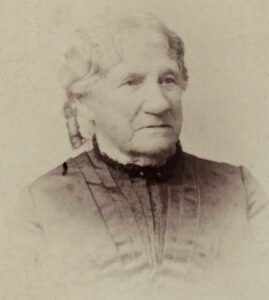
Margaret Cahoon in later years, 2000.P.FIC.007
Margaret Dickson Van Allen Cahoon (b. 1810, d. 1894) wrote down her memories in 1890, near the end of her life. In it, she tells her children about her early life growing up in Washington D.C. where she lived through the taking of the Capitol in 1812 and how she conversed with many well-known statesmen and women who were important in the early years of America. She writes of her married life with one of Dover’s earliest settlers, Joel Cahoon, including their travels through Ohio. She recounts meeting Joel’s parents, Lydia and Joseph, and later settling into their home at Rose Hill with her growing family in 1842. Many details we know about the life of the first generations of Cahoons to settle in Dover (now Bay Village) come from her writings. You may read her memoir on our website under The Autobiography of Margaret Dickson Van Allen Cahoon.

Ida Cahoon, 1996.P.012
Margaret’s youngest child, Ida Cahoon (b. 1852, d. 1917), was proud of her family’s pioneer roots in Bay Village and wrote the history down many times. She was a teacher who worked in Cleveland. Her History of the Cahoon Family was used to help write Bay Village: A Way of Life. In 1896, she contributed to a publication about the pioneer women of Ohio, writing a chapter about Dover. Ida not only wrote about her own family, but also mentioned various notable women in the history of our town, retelling the history she was taught by her elders. She writes about the sad story of Sarah Osborn’s (b. 1779, d. 1856) sister, Rebecca Porter (b. 1777) who, along with her infant son, were drowned at Rocky River, coming back in a row boat from a trip to Cleveland in April, 1814. Ida names them the first to be buried in the Lakeside Cemetery. Another story was of the recently settled Stocking family from Massachusetts. Jane Fisher Stocking, who shared five children with her husband, Joseph, began a farm near Dover Center. Ida writes “Their early housekeeping was somewhat primitive and amusing. The dining table was the family chest, around which pumpkins were placed for chairs.” She spoke of women traveling to Dover writing “After a journey of ten weeks from the Isle of Man, Mrs. Margaret Clague and daughter Ruth walked from Cleveland, in 1837, to the farm now occupied by her children, which was ever afterward her happy home.” There is a link to an electronic copy of Ida’s article under our Useful Links Page on our website, titled Pioneer Women of the Western Reserve/Cuyahoga County (after clicking on the title choose “View All,” then start at page 58, Pioneer Women of Dover).
In 1965, Hazel Cousins Dorsey (b. 1907, d. 1998) wrote her memoirs as a descendent of early Dover settlers Elizabeth and Aaron Aldrich and Martha and Nathan Bassett. Her family history was typed and arranged in two parts, written and dedicated to her grandsons Donnie and Michael Yeargan, for their twelfth and thirteenth birthdays, teaching them about the origins of their family. This Topsy-Turvy Family tells about Hazel’s ancestors settling in Dover and later moving to California. Her second piece, Pioneering in Ohio, contains passages which were quoted in Bay Village: A Way of Life and are listed as a resource. There is a section about the American Indians who also used the lands in Dover for activities such as hunting and collecting maple syrup. Native women are mentioned, but only as far as their interactions with white settlers. Hazel tells of the daily life and hardships endured by some of these early settlers of Dover and the surrounding communities. Food and drink, clothing, work, illness, schooling, churches and the Civil War are given sections in the piece. There are stories of women getting lost in the woods, chasing off bears and living in the wagons that brought them to Dover until a cabin could be built. Woven in, occasionally, are her own family’s stories. We are currently working on transcribing a copy of Hazel’s work about the pioneers which will be added to the Bay Village Historical Society’s webpage in the near future. Look for it as it is a fascinating read.
******
If historical documents such as these are important to you, please consider a donation to the Bay Village Historical Society. Find out more on our website Support Us Page. You may also contact us by phone at (216) 319-4634 or email info@bayhistorical.com.
Rose Hill and the Osborn Learning Center are closed to the general public until Sunday, April 16, 2023. Please come and visit us this spring!

Letter from President Harrison to Margaret Cahoon, March 6, 1889
by Michele Yamamoto
We continue to discover new surprises in the collections at the Bay Village Historical Society. One such discovery happened last year when two of our archival volunteers, Jack Hanley and Bill O’Brien, came across a letter from a newly inaugurated President Benjamin Harrison. It is dated March 6, 1889, only two days after he was sworn in as the 23rd President of the United States. The typed letter is an acknowledgement of the receipt of what must have been a letter of congratulations by Rose Hill’s own Margaret Cahoon.

Letter from Benjamin Harrison, 2000.FIC.02.262
Margaret A. (Dickson) Van Allen Cahoon (b. 1810, d. 1894) came to live in the area we now know as Bay Village in 1842. She was the wife of Joel Butler Cahoon (b. 1793, d. 1882) who, along with his parents and siblings, was the first to settle in what was then known as Dover Township on October 10, 1810. The family built a framed house in 1818. Margaret later named it Rose Hill because of the abundance of rose bushes that had been planted by her mother-in-law, Lydia.
Margaret was born and raised in Washington D.C. and through her short autobiography written near the end of her life in 1890, we know something about her time growing up there. You may read her transcribed memories on our website under The Autobiography of Margaret Dickson Van Allen Cahoon. Margaret was there as a young child during the War of 1812 and remembered seeing the Capitol building blackened with smoke, the eagle over the Speaker’s chair broken and graffiti on the walls and columns. She was present at the inauguration of President Monroe in 1817 and remembered First Lady Dolly. Margaret wrote that she became friends with one of their grandchildren. Her father, John Dickson, took her to sessions of the Supreme Court where she visited with the judges who took an interest in her education. She would walk by the Capitol on her way home from school and stop in, at times, to hear debates from the likes of John C. Calhoun, Henry Clay and Daniel Webster, among others. The family was friendly with many congressmen and judges.
After marrying Joel Cahoon in 1831, Margaret left Washington, later making the effort to visit three times. One of these journeys was made to see the inauguration of 14th President, Franklin Pierce, during which she rode a train for the first time. Her parents were buried in the Congressional Cemetery and it’s not a stretch to think she had many old friends to visit in the city as well.
The Harrison family could also be one of those visited considering that Benjamin’s grandfather, William Henry Harrison, had been President and his father, John Scott Harrison, served two terms as a U.S. congressman from Ohio. Margaret writes that Joel attended the burial of the first President Harrison in 1841 in North Bend, Ohio, near where her young family was living at the time.
If you are interested in finding your own “treasures” of history in our collections, please think about donating your time as a volunteer to the Bay Village Historical Society. You may find out more about ways you can help us on our website Support Us Page. You may also contact us by phone at (216) 319-4634 or email info@bayhistorical.com.
Rose Hill and the Osborn Learning Center is closed to the general public until April 2023. Please come and visit us this spring!

Bay Village Library, part 1 Dover-by-the-Lake
As Bay Village prepares for the opening of its much-anticipated new library, we at the Bay Village Historical Society would like to share with you some library history from our collections.
The following early history of the library in Bay Village is from an article written by Bay Village Historical Society board member, Cynthia Eakin. It is part 1 of a three-part history that we will be sharing with you for the next few installments of Glimpse of the Past.
If you would like to find out even more about the library or Bay Village history in general, contact us at (440) 871-7338 or email us: info@bayhistorical.com.
We hope to see you at the Bay Village Branch of Cuyahoga County Public Library during their Grand Opening, Saturday, April 30 from 2-5pm in the new location at 27400 Wolf Road.
History of the Bay Village Library—Part 1, by Cynthia Eakin
Cahoon Will established the first library in Bay Village
The first settler in Bay Village was Joseph Cahoon, whose youngest granddaughter, Ida Maria Cahoon, left the family estate to the city for a library.
The Cahoon family settled along the Indian trail, now Lake Road, in 1810. In 1818, their permanent home, called Rose Hill, was built where it now stands. The third son of Joseph Cahoon married Margaret Van Allen, and their 11 children were all successful, prominent citizens. Three of their daughters, Lydia, Laura and Margaret were teachers in the Cleveland school system, and a fourth daughter, Ida, was a writer of prominence in the field of poetry. So, it was natural for a family interested in education to foster learning by establishing a library.
The library was made possible through the will of Ida Maria Cahoon. In her will, she asked that the name be, “Dover-by-the-Lake Library,” should another library ever by organized in what was then Dover Township.
The Cahoon estate consisted of 114 acres, the ancestral home of Rose Hill and the barn, left in trust to Mayor Walter Wright, city council, and their successors. The will stipulated that Rose Hill was to be used for a library and museum, and the surrounding land was to be used as a park. Item 25 of the will states, “I hereby direct and request that steps be taken by said Mayor and Council of the Village of Bay to enlist the attention of Mr. Andrew Carnegie, and solicit his help and assistance in establishing and maintaining said library. I hereby give and bequeath to the Library of Dover-by-the-Lake herein intended to be created, all of my books, pictures and I request that the family portraits and best pictures be placed on the walls of the Cahoon homestead, and be forever maintained therein.”

2022.P.08.11.07 Dover-by-the-Lake Library located at Rose Hill, May 25, 1959
A committee of 12 members was appointed on Feb. 2, 1920 to organize and develop a program for a public library. This committee met formally on Dec. 10, 1920 with their recommendations. On Mar. 18, 1921, Mrs. Emma Paul Pope and Miss Olive P. Bailey were appointed associate librarians. They planned and organized the library and opened it to the public on May 24, 1921. There were 80 people present, which was a sizable crowd in a village of 750 people.
Ida Cahoon’s will established two trust funds known as the “Library of Dover-by-the-Lake Fund,” to buy books, maintain, support and care for the library. This fund, plus fines and a small sum from the village general fund, financed the library from its beginning until 1935, when it became eligible for funds from intangible taxes.

R2021.01.10 Julia Osborn Scott
Mrs. Julia Osborn Scott was appointed resident librarian on Oct. 1,1922, and continued until 1946. Scott was the great granddaughter of Reuben Osborn, one of the first settlers of Bay Village. She not only knew her library collection, but she knew the village and all of its inhabitants, and many of their ancestors, if not by personal relationship, then by stories, folk lore and traditions passed down from one generation to the next. From her own family, she learned of the trials and hardships the pioneers endured as they traveled west into Ohio. Since Scott was steeped in the folk lore, manners and customs of the pioneers, she gave this information as freely as she lent a book.
Every newcomer to the village knew the library and Mrs. Scott before knowing anyone else, except perhaps their minister. The library was the center of interest, and there was a personal relationship between the librarian and her patrons that would not exist in larger communities. Scott lived in the upstairs of the library building from her appointment in 1924 until her retirement in 1946. Her quarters were described as being homey and interesting, as there were books everywhere.
Although there was always work to be done, Scott took the time to relate experiences that had no relation to the borrowing of books or reference readings, such as the time a Gypsy family took refuge in the library, since it was the nearest house when their baby became sick. They remained two weeks, but with all of the care they could give, the child died and was given a decent burial in the cemetery by the lake. Then, there was the incident when two men who had imbibed too much, broke into the library on a very cold night and slept on the couches downstairs. Still slightly tipsy in the morning, they proceeded upstairs to wake the librarian to ask her to intercede with the police on their behalf.
During the Depression years and until after WWII, the library hours were irregular and long for one person supervising alone. Because Scott lived in the building, many people would drop in at their convenience. The average number of hours from 1923 to 1934 were not recorded, but from 1934 to 1937, 34 hours a week were scheduled. Between 1937 and 1948, the number increased to 48 hours. There was no regular assistant, yet the services and circulation continued to increase. The library was known first as a Private Trust Library, then it became a municipal library and finally a branch of the Cuyahoga County Library System.
The Mayor and city council leased the dwelling house to the Board of Library trustees, furnished custodial services, water, gas and electricity, and paid the sum of $1,000 a year out of the Dover-by-the-Lake Library fund for use in operation and maintenance of the library. This agreement lasted from 1943 to 1952.
The information in this segment of the series on the history of the Bay Village Library was gathered from, “History of the Dover-by-the-Lake Library of Bay Village, Ohio” by Ruth R. Lephart, submitted in partial fulfillment of the requirements for the Degree of Master of Science in Library Science, School of Library Science, Western Reserve University, June, 1954.

2022.P.FIC.05.2 Lake Erie Junior Museum event (now Lake Erie Nature & Science Center) inside the library at Rose Hill, circa the late 1940s.

Smoke House and Jail
A. Horace Wolf, who became the second mayor of Bay Village, serving from 1910 to 1915, lived on a property given to him by his father, Alfred, at 492 Bradley Road. (Horace had an airport in the 1920s located on the land behind St. Barnabas Church.) The old stone smoke house that stood behind the homestead house was used as a jail prior to Horace’s becoming mayor. It was used to lock up prisoners until the Marshall could take them to the county jail.
The large homestead was purchased by the city and the house, about 101 years old in August 1973, was torn down to make way for the new Jaycee Community House, now the Bay Lodge. The smokehouse was moved near the herb garden just south of Rose Hill Museum, where it stands today.

Cahoon Replica 1810 Cabin
Joseph Cahoon and his family drove into the valley in Dover Township, now Bay Village, on Oct. 10, 1810. Since winter was approaching, it was imperative to create shelter. They built a cabin on the east side of a creek near the lakeshore in four days. In 1818, construction of their permanent home was completed at the top of the path along the lake and it now houses Rose Hill Museum. In 1976, Bay Village Mayor Henry Reese established a commission to plan historical events for the American Bicentennial. Boy Scout leaders John Brant and Donald Harris, along with members of the Bay Village Girl and Boy Scouts, their parents and friends, worked 3,900 hours to construct the pioneer cabin. A ribbon cutting was celebrated on Oct. 10, 1981, 171 years after the arrival of the Cahoons in Bay Village.