

While the Cahoon sisters were teaching in Cleveland they lived in a house at 1916 Broadway. They sometimes shared the house with other teachers, such as Ada Hine, a teacher who is listed as a boarder at 1916 Broadway in the 1900 census. On the weekends and during breaks, they would take the train out from Cleveland to Rose Hill.
Category Archives: Cahoon

Frame #19: Effie Cahoon Ellis
b. 1861, Cleveland, Ohio
d. 18 April 1888, Cleveland, Ohio
Effie Cahoon was the first and only child born to Thomas and Elizabeth Cahoon. She married Dr. Clifton D. Ellis on October 24, 1883. This photograph was likely taken of her wearing her wedding dress from that day. Her husband had a general practice and was a professor of Osteology and Minor Surgery at the Cleveland University of Medicine and Surgery. She died of tuberculosis at the age of 27 and is buried in Lakeside Cemetery.

Frame #21: Anna M. Taintor Cahoon
b. 1871, Illinois
d. unknown
Anna M. Taintor Cahoon was the adopted daughter of Thomas and Elizabeth Cahoon. She was a painter, designer, and interior decorator in Cleveland from the mid-1880s to at least 1897. She graduated from the Wester Reserve School of Design in 1888 and attended classes at the Cleveland School of Art while working at William Otis’s Household Art Company. She was listed as an artist in the 1893 Cleveland City Directory. In 1896, Anna partnered with Amy E. Smith in a decorating and applied art business that they had at least until 1898.
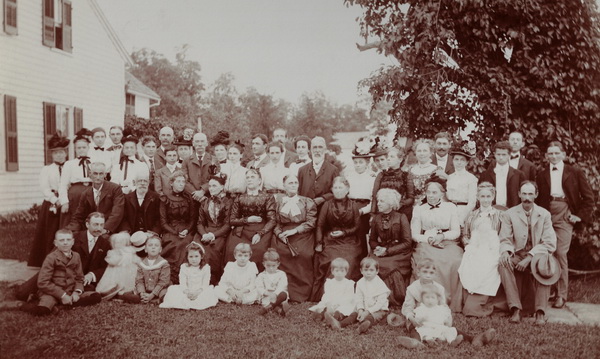
Frame #22: Cahoon Family Reunion
The descendants of Joseph and Lydia Cahoon gathered for a reunion at Rose Hill sometime after 1899 (John Marshall’s death), but before 1903 (Martha’s death). The reunion included the Wright, Bullock, Hollenbach, and Andrews families. The Wrights are the descendants of Joseph and Lydia Cahoon’s daughter, Rebecca. The Bullocks and Hollenbachs are descendants of Joseph and Lydia Cahoon’s son, Benjamin. The Andrews family is very distantly related to the Cahoons but were considered close family friends.

Top Row: 1-6. Unknown, 7. Walter Wright, 8. Tom Wright, 9. Maria Palmer Wright, 10. Aaron Bullock, 11. Bertha Wilbur Bullock, 12. Mabel Bullock, and 13. Alva Bullock. Middle Row: 27. Everett Benjamin Cahoon, 28. Thomas Cahoon, 29. Martha Cahoon, 30. Helen Cahoon Bullock, and 31. Jeannette Cahoon. Bottom Row: 38-43. Unknown

Top Row: 14. Mary Hollenbach, 15. Unknown, 16. Lulu Hollenbach Manter, 17. Reuben Hollenbach, 18. Elizabeth Hollenbach Dougherty, 19. Unknown, 20. Ida Cahoon, 21. Unknown, 22. Jay Collin Andrews, 23. Lillian Spoor Andrews, 24. Edwin R. Andrews, 25. George Andrews, and 26. Unknown. Middle Row: 32. Minerva Cahoon Hollenbach, 33. Lydia Cahoon, 34. Laura Cahoon, 35. Abigail Cahoon Schneerer, 36. Maria Webb Andrews, 37. Frank Andrews. Bottom Row: 44. Unknown, 45. Virginia Andrews Hutchinson, 46. William Harron Andrews, 47. Jay Andrews, 48. Dan Andrews, and 49. Louise Andrews Sanders.

Frame #25: Joel and Margaret Cahoon’s Sons
Joel and Margaret had six sons, five of which survived to adulthood. Of the five, only Thomas married. Thomas and John Marshall were the only two brothers to outlive their mother.
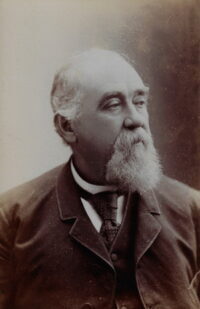
Thomas Havenner Cahoon
Frames #8, #15, #25
b. 7 July 1832, Fredericktown, Maryland
d. 16 Apr. 1907, Cleveland, Ohio
Thomas Havenner Cahoon was the eldest child of Joel and Margaret Cahoon. He was the only child to ever marry, marrying Elizabeth Hughes on March 27th, 1860. He was a member of the Cleveland City Council, a partner in the lumber firm Cahoon & Hutchinson as well as in the manufacturing firm Moore, Cahoon, & Co. He passed away at the age of 75 and was buried in Lakeside Cemetery.

John Joseph Cahoon
b. 9 Jan. 1834, Fredericktown, Maryland
d. 4 Mar. 1894, Dover, Ohio
John Joseph Cahoon was the second child of Joel and Margaret Cahoon. He grew up at Rose Hill but later moved to Memphis, Tennessee where he worked as a mechanical engineer. He returned to Rose Hill when he contracted tuberculosis. He passed away at the age of 60 and is buried in Lakeside Cemetery.

Daniel Kenyon Cahoon
Frames #25, #30
b. 25 Jan. 1838, Clear Spring, Maryland
d. 15 Feb. 1890, Cleveland, Ohio
Daniel Kenyon Cahoon was the fourth child of Joel and Margaret Cahoon. Little is known about his life including what he did for a living. However, in the 1880 census he was listed as a ticket agent. He never married. Daniel passed away at 52 and is buried in Lakeside Cemetery.

Leverett Judson Cahoon
Frames #11, #25
b. 14 Nov. 1845, Dover Township, Ohio
d. 16 Aug. 1886, Dover Township, Ohio
Leverett Cahoon was the eighth child of Joel and Margaret Cahoon. He took over the farm after Joel became too ill. In addition, he and his younger brother, John Marshall Cahoon, became proprietors of the Cahoon Store around 1860. The brothers also started a fishery, as well as shipped fruit on the Nickel Plate Railroad, which had built a train station adjacent to their store. He lived to be 41, when he passed away of typhoid fever. Leverett is buried in the family lot in Lakeside Cemetery.

John Marshall Cahoon
Frames #15, #25, #27
b. 29 July 1847, Dover Township, Ohio
d. 8 Aug. 1899, Dover Township, Ohio
John Marshall Cahoon was the ninth child of Joel and Margaret Cahoon. He often went by “Pat” or “Patrick.” He was appointed the postmaster of North Dover in 1892. He passed away at the age of 52 when his carriage overturned on his way home from the Cahoon Store. John Marshall is buried in the family lot in Lakeside Cemetery.

Frame #26: Joel Butler Cahoon
A series of crayon enlargements of family photographs continue to be displayed on the walls of Rose Hill. This photograph of Joel Cahoon was enlarged by John Kavanagh of Cleveland in 1881. He studied at the National Academy of Design in New York, studied genre painting in Munich, and studied at the Académie Julian in Paris. In Cleveland he became well known for his portraiture, specifically in crayon as seen here. Kavanagh also painted landscapes, including one of Rose Hill which hangs in the 1818 parlor. In 1889, he became the director of the Art Club in Cleveland, teaching portraiture and figure painting. He passed away in 1898. To read more about Joel Cahoon, visit frame #5.

Frame #27: John Marshall Cahoon
This photograph of John Marshall Cahoon served as the reference for a crayon enlargement by an unknown artist. The enlargement process began with the sun. A camera with an angled mirror captured the sunlight and directed it through the photo negative and an enlarging lens onto a piece of treated paper. This took several hours, and the mirror had to constantly be adjusted to account for the sun’s movement. Between this and any inherent flaws in the image now seen at a much larger scale, they almost always had to be retouched and enhanced using crayons and paint. A skilled artist could maintain the original photograph’s realism, providing a portrait that was worthy of framing and hanging on the wall.
To learn more about John Marshall Cahoon go to frame #25.

Frame #28: Martha Washington Cahoon
This portrait of Martha Washington Cahoon was done by an unknown artist. It may be a crayon enlargement, although the effect is more painterly than Joel’s or John Marshall’s. To learn more about Martha, visit frame #17.

Frame #29: Lydia Elizabeth Cahoon
This crayon portrait of Lydia Elizabeth Cahoon is signed “Tanquerey, Brooklyn, N.Y.C.” A positive identification of the artist is difficult, although an ‘A. Tanquerey’ won a Medal of Merit in photographs and crayon portraits in 1890. However, Tanquerey is also associated with a crayon portrait scam. In a 1891 circular for the Tanquerey Portrait Society, signed by an ‘A. Tanquerey,’ a free crayon portrait is advertised. An interested party would send a photograph to be turned into a larger portrait free of charge.
The deal was too good to be true. After the photograph was sent, the customer would be sent a pamphlet advertising extravagant frames they would have to buy before receiving their original photograph and portrait. If the customer refused, they would receive neither. In 1893, the Tanquerey Portrait Society was banned from using the U.S. mail. A few years afterwards the scam was running in France and Australia, with warnings of the ‘swindle’ being printed in the newspaper.
It appears that Lydia was able to secure a quality portrait from Tanquerey. Maybe she decided the frame was worth the trouble, or Tanquerey had yet to turn his crayon portrait business into an international scam.
To learn more about Lydia, go to frame #17.
Frame #30: Daniel Kenyon Cahoon
This photograph of Daniel Kenyon Cahoon was used to make a crayon enlargement similar in style to Martha’s portrait. To learn more about Daniel, visit frame #25.