Christmas Cards of Bay Village Notables

During Cahoon Christmas 2023 events, the Bay Village Historical Society will be showcasing an exhibit of Christmas cards and imagery in our library. The pictures were created by artist Thomas William Jones, a Bay Village native. Jones recently and very generously donated examples of his work to the Society this year. Jones’s work was chosen as the feature image for President Ronald Reagan and Vice President Dick Cheney’s official Christmas cards. You may view them in person during December at the Rose Hill Museum.

Jones’s cards inspired us to look at some other holiday greetings in our collections. Enjoy this look into the past and happy holidays from the Bay Village Historical Society!

Christmas postcard from Ida Maria Cahoon to Miss Sarah Dodd, circa 1910s, 2012.05.2.

Christmas card from Ernest and Alvina Wuebker to their daughter, Vera. Ernest was the first rural postman of West Dover Township from 1903-1935 and his daughter was part of Bay’s first graduating senior class in 1927, 2018.03.70.

Telegram from Ernie Olchon to his future wife, Dorothy, circa the late 1930s. They were married in 1940. From 1940-1971, Olchon owned Ernie Olchon’s Bay Service Station, at Wolf and Dover Roads, 2018.11.14AB.

President and Mrs. Ronald Reagan’s official Christmas card, 1988. Art by Thomas William Jones, 2023.13.02.
This image has an empty alt attribute; its file name is 2023.13.02Ainside300DS-Copy.jpg

The final Cahoon Christmas 2023 event days will be held Sunday, December 17, from 2:00-4:30 p.m. and Wednesday, December 20, from 4:00-7:00 p.m. You may find a list of special performances and demonstrations on our website at www.bayhistorical.com. Click on Our Events on the homepage menu to access the Calendar. Contact us at (216) 319-4634 / info@bayhistorical.com, with any questions.

1800s Sleigh at Rose Hill Museum

The Bay Village Historical Society usually asks that visitors do not sit upon any of their antique collections. In December, there will be an exception. An 1800s sleigh will be available for picture taking with Santa Claus during the Cahoon Christmas event days.

The sleigh before the remodel, D.2019.5.1.

It is unclear where and exactly when the two-seater sleigh was built. We do know that it was most likely made sometime in the 1800s. The sleigh was owned most recently by Bill and Grace Anderson Sebesta of Bay Village. Their niece, Bernardette E. Novy Enochian, donated it to the Bay Village Historical Society in 2019. It was restored soon after and painted red and black for the holiday season. The sleigh made its makeover debut for Cahoon Christmas 2022, during which Santa, Mrs. Claus, and their elves joined the festivities and posed for pictures with visitors at Rose Hill Museum.

The sleigh being rebuilt, D.2019.5.1

If you would like to take a photo of your loved ones with Santa at Rose Hill Sunday, December 10, from 2-4 p.m., sign up on our website at Cahoon Christmas 2023 and for a $20 donation, a professional photographer will take a digital photo that will be emailed to you. Walk-ups are welcome at $25 cash. The proceeds will help fund activities and collection preservation at the Bay Village Historical Society.

The 2023 Cahoon Christmas event will be held Sundays, December 3, 10 and 17 from 2:00-4:30 p.m. and Wednesdays December 6, 13, 20 from 4:00-7:00 p.m. You may find a list of special December performances and demonstrations on our website at the following link: Events Calendar. Contact us at (216) 319-4634 / info@bayhistorical.com, with any questions.

Antique brass sleigh bells, 2006.L.04

1899 children’s book “The First Sleigh Ride,” 2021.B.FIC.010

Happy Thanksgiving!

The following postcard, sent in 1938 to Henry and his sister, Olga Wischmeyer, says it all. Best wishes to to you and yours this Thanksgiving, this time from the Bay Village Historical Society.

Who are Henry and Olga Wischmeyer, you ask? They were the children of Henry and Regina Wischmeyer, the owners of a popular resort hotel in 1800s Dover (now Bay Village). The hotel, which used to stand on the Lake, just west of Glen Park, is now gone. The home of Henry and Olga, though, still stands today.

Some artifacts of the Wischmeyer Hotel were saved and can be viewed at the Rose Hill Museum, along with Henry Jr.’s collection of model boats. You may come see these exhibits Sundays (excluding holiday weekends), 2:00-4:30 p.m. In addition, come visit Rose Hill during our special 2023 Cahoon Christmas Event, Saturdays, December 3, 10 and 17 from 2:00-4:30 p.m. and Wednesdays December 6, 13, 20 from 4:00-7:00 p.m. You may find the list of special performances, demonstrations and photos with Santa on our website https://www.bayhistorical.com/. Contact us at (216) 319-4634 / info@bayhistorical.com, with any questions.

d Olga Wischmeyer, you ask? They were the children of Henry and Regina Wischmeyer, the owners of a popular resort hotel in 1800s Dover (now Bay Village). The hotel, which used to stand on Lake Road, is now gone. Some artifacts remain at the Rose Hill Museum, along with Henry Jr.’s collection of model boats.

You may see these exhibits Sundays (excluding holiday weekends), 2:00-4:30 p.m. In addition, come visit Rose Hill during our special 2023 Cahoon Christmas Event, Saturdays, December 3, 10 and 17 from 2:00-4:30 p.m. and Wednesdays December 6, 13, 20 from 4:00-7:00 p.m. You may find a list of special performances, demonstrations and photos with Santa on our website homepage. Contact us at (216) 319-4634 / info@bayhistorical.com, with any questions.

Back of Thanksgiving postcard, 2021.FIC.018

Woman Suffrage Amendment Poster, 1914

by Michele Yamamoto

At the Bay Village Historical Society, we made an unexpected discovery while archiving the college diploma of Elizabeth Hughes Cahoon. The backing used inside the frame for Elizabeth’s diploma was from the women’s suffrage movement in the early 1900s. The poster reads “Vote for Woman Suffrage Amendment 3 on Nov. 3.” A look into Amendment 3 led us to discover this political campaign poster was referring to an attempt in 1914 to initiate an Ohio state constitutional amendment to provide women the right to vote. Suffragists up to this point had been trying to pass state initiatives such as this one to compel the United States Congress to submit a federal amendment. Fifteen other states managed to pass suffrage ballot measures. The amendment cited on the poster was the second attempt to extend the suffrage to women in the state of Ohio. The first attempt on September 9, 1912 failed. The November 3, 1914 attempt also failed, with 60% of the male only voters voting against it, about 3% more than in 1912.

Elizabeth (b. 1830, d. 1914) joined the Cahoon family when she married Thomas Havenner Cahoon (b. 1832, d. 1907) in 1860. Thomas was the son of Joel and Martha Cahoon, the second-generation homeowners of Rose Hill. Before marriage, Elizabeth graduated from Wesleyan Female College in Cincinnati in 1852 with a degree of Mistress of English Literature. This was no ordinary feat in the 1800s, a time during which most American women were discouraged from attending institutions of higher learning.

A young Elizabeth Hughes Cahoon, 2000.P.FIC.013

Thomas Havenner Cahoon,1996.P.008A

Elizabeth Hughes Cahoon’s 1852 college diploma, 2021.FIC.004

Knowing her background, it makes one wonder if she supported the 1914 measure or maybe even campaigned for it. Elizabeth attended college during the very early years of the suffrage movement, which appears to have had a strong presence in Ohio. In a college journal entry from January 11, 1851, Elizabeth wrote that she attended a meeting at a public lecture hall during which she “heard much of woman’s wrongs and rights.” Interestingly, in May of that year, there was an Ohio Woman’s Rights Convention held in Akron, during which abolitionist and women’s rights activist, Sojourner Truth, spoke.

Elizabeth Hughes Cahoon in later years. 2023.P.FIC.011

Elizabeth Hughes Cahoon died on October 4, 1914, one month before the outcome of the November vote. She is buried in the Bay Village Lakeside Cemetery. Almost six years later, on August 26, 1920, the ratification of the 19th Amendment of the U.S. Constitution is certified. It prohibits government from denying or abridging the right to vote on account of sex.

**********

If you enjoy reading Glimpse of the Past, please consider a donation to the Bay Village Historical Society. We rely mainly on the support of private donors to preserve and share our local history. Donations can be made online on our “Support Us” page. You may also contact us at (216) 319-4634 or info@bayhistorical.com.

1914 Woman Suffrage poster, 2021.FIC.005. A portion of the bottom was cut to fit into a frame as backing. It may be viewed in person in a display at Rose Hill Museum through November 12, 2023.

Halloween Costumes of Yesteryear

by Michele Yamamoto

This week there are many Bay Village families planning what to wear for Halloween. From parties to trick-or-treating, there will be many opportunities to show off costumes. The following photos are a glimpse into some Halloween costumes of Bay Village past. May they take you back to your childhood or inspire you to recreate one today!

The first Kindergarten class in Bay Village Schools, October 1941. The kids pose for a group photo in their costumes. More on this class can be found in the Bay Blue Book from 1954, which can be viewed virtually on the Bay Village Historical Society website.

Two photos of Betsy Andrews leading a 1975 Halloween Story Time program at the old Bay Library building where the Bay Board of Education is currently located. Although this is slightly before my time, I did wear that same Casper mask one year and remember well the plastic bib costume and mask sets that continued to be sold well into the 1980s. 2022.P.08.14.02.03.1.3 & 4

A Halloween event circa the early 1990s at the Lake Erie Nature & Science Center. I see a Mario brother but no Ninja Turtles here. 2021.P.FIC.295

If you are concerned about preserving Bay Village’s past (even our more recent past) consider donating to the Bay Village Historical Society. You may visit our website Support Us Page, contact us by phone at (216) 319-4634 or email info@bayhistorical.com. Also, feel free to contact us if you know any of the unnamed people in the photos.

Lutheran Mission Grounds Bell

The following piece was researched using articles written by Bay Village Historical Society historians George Serb and Kay Laughlin, who shared their knowledge of the subject in 1997 and 2013, respectively.

The next time you visit the grounds of the Rose Hill Museum, you will notice near the south porch a cast iron bell now hanging near the staircase down to the Cahoon cabin. This bell has historical significance as it used to hang next to the pulpit of the old Lutheran Mission Grounds.

A map of Bay Village’s west side from sometime in the 1930s or 1940s, showing the location of the Lutheran Mission Grounds, 2018.FIC.0017

A map of Bay Village’s west side from sometime in the 1930s or 1940s, showing the location of the Lutheran Mission Grounds, 2018.FIC.0017

The Lutheran Mission Grounds was an outdoor gathering spot in Bay Village, used by various Lutheran churches from the west side of Cleveland during summers from June to September. It was located between Bassett and Bradley Roads, reaching south to the railroad tracks, with a road north to Ashton Lane (formerly Link Road). The 10-acre site was purchased from farmer David Sites in 1886 by the churches who were looking for a wooded piece of land out in the country. They eventually erected buildings to house mission festivals, school picnics and other church gatherings. Those attending could ride the train from Cleveland to the site, later driving when automobiles became the preferred mode of transportation.

George Serb remembered visiting the grounds in the late 1930s. Serb’s Lakeshore Ice Company delivered to Lutheran Mission Grounds on Sunday mornings for the refrigerators and coolers located in the large kitchen. A single lane bowling alley (built in 1904), upon which the pins had to be set by hand, was one unique feature Serb recalled using with his classmates. He mentions that a Mr. William Toensing, who lived near the property with his son Leonard, was the caretaker.

Carl Meilander and Victor Toensing play at the bowling alley on the Lutheran Mission Church Grounds, circa the 1930s, RP.01.009.03

Carl Meilander and Victor Toensing play at the bowling alley on the Lutheran Mission Church Grounds, circa the 1930s, RP.01.009.03

The bell has served different purposes over the years. The original bell of the Lutheran Mission Grounds was stolen at some point and replaced with the steam engine bell you see at Rose Hill. It was donated to the church by the New York Central & St. Louis Railroad. When the Lutheran Mission Grounds closed in 1964, that bell was given to the Victor Toensing family for safe keeping. Janet Toensing Bremke took it with her when she moved to Amherst. Janet and her brother Carl Toensing then gifted the bell to the Bay Village Historical Society in 2011, in memory of their brother Robert.

You may see the Lutheran Mission Grounds bell anytime outside of the Rose Hill Museum in Cahoon Memorial Park. Tours of the inside of the home are given Sundays in April through December from 2:00 p.m. to 4:30 p.m. (excluding holiday weekends). Our temporary exhibition, Beadwork: The Beauty of Small Things is currently on display, along with our permanent collection of early American artifacts. You may also contact us at (216) 319-4634 / info@bayhistorical.com.

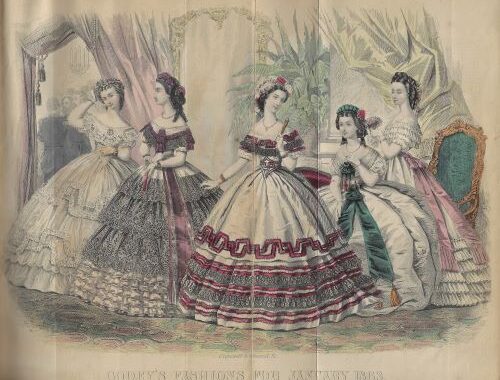
A fashion fold-out from the Godey’s Lady’s book, 1863, Vol. 66, part of the Rose Hill Museum library collection.

Women’s Fashions: 1860s-1920s

(Feature image above: 1860s – A fashion fold-out from the Godey’s Lady’s book, 1863, Vol. 66, part of the Rose Hill Museum library collection.)

In anticipation of our upcoming benefit fashion show being held this September (details below), we at the Bay Village Historical Society would like to share some pictures of interesting women’s fashions from the 1860s-1920s, that we have found in our collections. You may see quite a few fashionable dresses and accessories any Sunday at the Rose Hill Museum, especially with our current exhibition, Beadwork: The Beauty of Small Things. The following pictures are not always on display and many are tucked away in our library and archives. Enjoy!

1870s – The Cahoon sisters, left to right: Lydia (b. 1835, d. 1917), Laura (b. 1841, d. 1917), Martha (b. 1844, d. 1903) and Ida (b. 1852, d. 1917), 1996.P.016. The photograph is undated but we can guess at the time period, in part, by the dress of the four sisters. The abundance of ruffles and trim on both the skirts and bodices, the bustles and the cascade of hair curls seem to indicate this photo was taken sometime in the early to mid-1870s.

1880s – Effie Cahoon Ellis (b.1861, d.1888). This portrait photograph was most likely taken on her wedding day in 1883. 2000.P.FIC.014

1890s – Puffed sleeves were all the rage in the mid-1890s, the time period in when we believe this picture was taken of Annabelle Aldrich Terry (b. 1873, d. 1950). 2021.01.1.007

1900s – Mabel Peters (b. 1884) is wearing the “S-bend” style dress, popular in the early 1900s. 2018.P.03.03.84  

1910s – Wedding fashion from the 1910s. This group photo was taken for the 1914 wedding of Meta Stark Hinz (b. 1890, d. 1955) and Arthur Hinz (b. 1890, d. 1956). Meta’s wedding dress is part of The Bay Village Historical Society’s costume collection (2005.P.01).

1920s – Martha Bassett Beaucock (born Aldrich) (b.1865, d.1957), 2021.P.FIC.228.08. With her cloche hat, Mary Jane shoes and drop waist dress, Martha screams the 1920s.

If you love historical fashions from the 1860s-1920s, then you’ll want to attend the Bay Village Historical Society’s benefit fashion show. Silhouettes of Style, co-chaired by Monica Thomas and Pamela Ebert, will be held September 24, 2023 at the Lakewood Country Club. Models will be showcasing both historical and reproduced pieces from private collections. Tickets for this luncheon are $45 a person. Checks payable to the Bay Village Historical Society may be mailed to Pamela Ebert, 153 Kensington Circle, Bay Village, OH 44140. The deadline for reservations is September 19. Details can be found at www.bayhistorical.com.

A Child’s Memory of the Cahoon Sisters

by Michele Yamamoto

At the Bay Village Historical Society archives we have recently come across a couple of remembrances of the Cahoon sisters. They were written by two former residents of Bay Village who recalled their time growing up in the town over 100 years ago. It is an interesting peek into what the sisters, Lydia, Laura Martha and Ida Cahoon, may have been like.

In “Remembering the Cahoons,” written by Wilfred C. Swanker (1907-1983) for Westlife in 1982, Swanker wanted to make sure that the Cahoon sisters’ characters were correctly recorded. “They were very civic minded,” he wrote. They opened their property up to the public long before giving it to the City of Bay Village in 1917. “The Cahoons engendered a spirit which I feel still prevails today. Their foresight was superb. They were a decent and kindly family which lived their religion.”

Ida, Lydia and Laura Cahoon about 1910, 1996.P.012

Swanker remembered the ladies giving the public access to their beach. Children unaccompanied by parents were requested to check in with the Cahoons for their own safety. “They opened their beach and grounds to the public when nobody else did. They built dressing rooms for the public as well as a pair of outdoor toilets.” A set of men’s dressing rooms were on the west side of Cahoon creek and another for ladies was on the east side. Swanker notes that this was before the building of Huntington Beach, whose stone levees contributed to coastal erosion on the Cahoons’ beach.

Another account of the Cahoon sisters was handwritten on notepaper by Roger Jewitt (1891-1993) in 1959. He was sharing his memories after a call was put out by the Kiwanis Club in a local paper and as part of the 150th celebration of Dover Township (Bay Village). Jewitt stated that he was the youngest child of Dr. E.H. Jewitt, physician to the Cahoon family, who summered in a cottage on the Cahoon property from 1896 to about 1912. Roger jokes that his boyhood pranks may have caused the sisters to practically disinherit his father. Indeed, only a Dr. Clifton Dalton Ellis (the husband of Ida’s cousin, Effie Cahoon) is mentioned in the Cahoon will.

Jewitt also wrote about the Cahoon family and their beach. He hinted that the sisters could actually be very forgiving in the defiance of their rule of not allowing bathers on Sundays. “The religious old gals put up and still up (under their wills) on Cahoon Beach a sign ‘No Boating or Bathing on Sunday.’ Every Sunday A.M. with their field glasses they checked me as a bather and if the culprit turned up in the Methodist Church my violation was condoned because I washed for the Lord. Tough quandary each Sunday for a growing boy.”

Swanker does mention in his article that the women may have had an interesting bathing habit. “Saturday morning was quite practically set aside for taking a bar of Ivory soap (it floats) and modestly taking a bath while wearing your bathing suit. You had to be a bit of a gymnast.”

Cahoon Creek meeting Lake Erie at Cahoon Beach, October 1940, 2000.P.FIC.119

Perhaps the ladies were just softies for the kids. Swanker talks about how the sisters would talk to the children who visited them and take an interest in their activities. “They were school teachers and liked kids. I remember they often wore high lace collars. For some reason the collars interested me.” Jewitt remembered Ida “would cover my neck and face with kisses with loud smacking of lips, as I resembled my doctor father, her best friend, charity on a young boy’s part.”

The Fourth of July was a time of big celebrations in Bay over a hundred years ago and the Cahoon property was a part of this even before Bay Days. Swanker wrote that “the Cahoons threw open their grounds and people came from all over. Picnics were a must. There were other families with much land but it was always the Cahoons who offered. No one else did. We had lots of races and contests and the Cahoons gave prizes. Fireworks were not like they are now but we thought they were the greatest.”
Swanker mentions that the sisters were ahead of their time. One small example was given in the way Ida Cahoon (1852-1917) chose to commute to work. “I remember Ida, the little one, riding her bicycle to teach school in what is now Westlake. In those days, very few women ever learned to ride a bike. It was considered unladylike. The Cahoons were a very modern family. I wish I had their acumen and foresight.”

*********************

We hope you enjoyed this glimpse into the lives of the Cahoon sisters. If learning historical information such as this is important to you, please consider a donation to the Bay Village Historical Society. Find out more on our website Support Us Page. You may also contact us by phone at (216) 319-4634 or email info@bayhistorical.com.

Another way to support us is by attending our benefit historical fashion show Silhouettes of Style, September 24, 2023 at Lakewood Country Club. Details can be found on our website events and programs page at www.bayhistorical.com.

Come visit us Sundays, April through December (excluding holiday weekends) from 2 p.m.- 4:30 p.m. at the Rose Hill Museum. Currently on display for 2023 is our temporary exhibition, Beadwork: The Beauty of Small Things, as well as our permanent collection concerning early Bay Village history.

Clothing Featuring Ornamental Beadwork at Rose Hill Museum

by Barbara Comienski (Collections Volunteer/ Docent)

Rose Hill has a number of amazing costumes on display as part of this year’s special exhibition Beadwork: The Beauty of Small Things.

Undoubtedly, the embellishment of late nineteenth century clothing with jet beads or crystals was inspired by the replacement of candles with gas lighting which would pick up the glint of the beads. The use of jet beads resurged in the 1880’s. Near the first-floor staircase, the museum has a beautiful gown, the sapphire blue bodice of which is embellished with black jet beading. There are several types of black jet. Natural jet, derived from fossilized wood, is lighter in weight and shines rather than sparkles. These beads would be a harder type than Irish jet which is fossilized peat, vulcanite, a vulcanized rubber, or dark glass imitating jet.

Collar detail of 1860s black beaded dress, 1996.C.132

Throughout the first floor, visitors can see examples of black berthas, detachable collars, and bib like accessories also decorated with jet beading. Since beading was very labor intensive, few middle-class women had the time to embellish an entire garment or be able to afford to purchase one. Such accessory pieces allowed them to be fashionable and would also have been particularly helpful to quickly utilize in mourning attire.

As with the invention of sewing machine in the mid-nineteenth century, the turn of the century also relied on decorative stitching, pleating, or ruching effects for ornamentation. By the nineteen teens, fashion turned to metallic thread and sequins until glass beads returned to popularity in the 1920’s. A black dress at the front left of the Victorian Parlor illustrates this crossover in trends with elements of both. The squared neckline, straps, and hem are defined by sequins, while the bodice, sleeves, and skirt feature heavy beading.

Early 1900s beaded black dress with square neckline, 1997.C.131

The popularity with beading in the 1920’s was to catch the glimmer of the new incandescent light bulbs. Shimmering satin fabric also reflected the light. Literally, women personified a “dazzling” fashion statement. Often 1920’s dresses favored thin gauzy fabrics. Many of these dresses have disintegrated under the weight of the beads pulling the fibers of the fabric. Several Rose Hill dresses currently on display are laid out on furniture to prevent further damage; one example is the black beaded mustard colored dress on the green sofa. Note the repeating diamond design of the black beads, which emphasizes the fascination in geometric patterns during this part of the Art Deco period.

Detail of a floral bead design, Bay Village Historical Society

Fashion in the 1920’s was also influenced by exotic cultures. Amulets and other jewelry from ancient Egypt were often copied, as were the softly side pleated skirts from Egyptian art. Howard Carter had only recently discovered King Tut’s tomb in 1922. Several beaded appliques on display in the Cahoon Library of Rose Hill show the bright colors and interesting shapes emulating these ancient designs. A penchant for exotic cultures in general permeated mid to late 20s fashion; therefore, we see nature and animal motifs in ornamental beading of the time.

Wedding headpiece, 1941, 2022.C.15.05B

As one heads upstairs, the 1940’s wedding headdress, bedecked with pearls, gives a preview of the variety of eras represented by beading on the second floor. A mid twentieth century evening gown creates visual interest with the undulating overall patterns of silver and pink beads. Over the stairway is a black gabardine cape with a beaded stand-up collar. The front and back have beaded V-shape bottom edges. Black bugle beads form a swirl pattern on the main part of the cape. Continuing toward the Victorian bedroom, visitors can see a mid- nineteenth century burnt orange velvet bonnet, unique in the rim of sparkling beads framing the face. From the same period, a pale blue gauze fabric dress is displayed on the bed to preserve the garment. The profusion of beaded flowers on the bodice stresses this fragilefabric. Peeking into the children’s room, one notes the beaded flowers on the collars and pocket of the pink child’s dress from early in the twentieth century.

Child’s party dress, ca. 1890-1920, 1996.C.022

Fun vintage, but reproduction, beaded clothing can be found in the Early Settler section as one enters the basement displays. Two Campfire Girl dresses from early in the twentieth century replicate beaded Native American garb. Since treaties for land west of the Cuyahoga were not in effect until 1805, early settlers to the area would still periodically encounter a few Native Americans journeying or hunting.

1940s Campfire Girl uniform with bead accessories, 1996.C.207AE

These are just a few highlights of the amazing creations on display in our current special exhibition. We hope you can join us at Rose Hill soon. In addition, consider attending our benefit fashion show Silhouettes of Style, September 24 at Lakewood Country Club. Details can be found at www.bayhistorical.com.

Eclipses in Bay Village

The following article was written by Bay Village Historical Society members Jim and Barbara Comienski. Barbara has been a tremendous help to us as both a museum docent and collections volunteer. She is responsible for cataloging our doll collection and has assisted in the dating of our clothing collection, amongst other activities. In the past, Barbara and Jim served as BVHS secretary and vice president, respectively. Jim is a retired planetarium director and astronomy and geology teacher for Lakewood City Schools. He is a 48-year member of both the Great Lakes Planetarium Association and the Cleveland Regional Association of Planetariums. He is also a 48-year member of the Cleveland Astronomical Society and currently serves on its board. Jim is active in the Bay Village Kiwanis Club, which will be involved in activities in anticipation of the April 8, 2024 solar eclipse. The Comienskis have recorded some interesting history for us about past eclipses in Bay that we are sharing here with you.

Eclipses in Bay Village

by Jim and Barbara Comienski

Much of the Cleveland area is in preparation for the total eclipse of the sun next year on April 8, 2024.

The last one in our area that extensive – a full eclipse – was on June 16,1806, predating settlers but seen by Native populations as was an annular eclipse on April 3, 1791.

The area was then inhabited by Wyandot and, to the west, Shawnee tribes. Although treaties were established with Native Americans in 1795, the land only opened to settlers in 1805. The Prophet Tenskwatawa, who was the brother of the famous chief Tecumseh, had predicted the 1806 eclipse.

There were two annular eclipses in the area after 1806 that would have been experienced by early settlers. An annular eclipse is not total; a ring of sunlight is visible. The Cahoons would have seen the one on September 17, 1811. Another occurred as the area was becoming more settled on September 18, 1838. Northeast Ohio then experienced its next annular eclipse on May 10, 1994.

There have been lots of partial eclipses where only part of sun is covered, the most recent in 2017, when our area parks were filled with viewers. All eclipses require safe viewing procedures. The Northeast Ohio area will experience a partial eclipse again this fall on October 14. This will undoubtedly generate excitement for the total eclipse in April.

Destination Cleveland projects an influx of viewers of hundreds of thousands to the Cleveland area, including Bay Village. Both LENSC and Kiwanis are developing plans with the city for possible events.

******

If learning historical information such as this is important to you, please consider a donation to the Bay Village Historical Society. Find out more on our website Support Us Page. You may also contact us by phone at (216) 319-4634 or email info@bayhistorical.com.

Come visit us Sundays, April through December (excluding holiday weekends) from 2 p.m.-4:30 p.m. at the Rose Hill Museum. Currently on display for 2023 is our temporary exhibition, Beadwork: The Beauty of Small Things, as well as our permanent collection concerning early Bay Village history.